
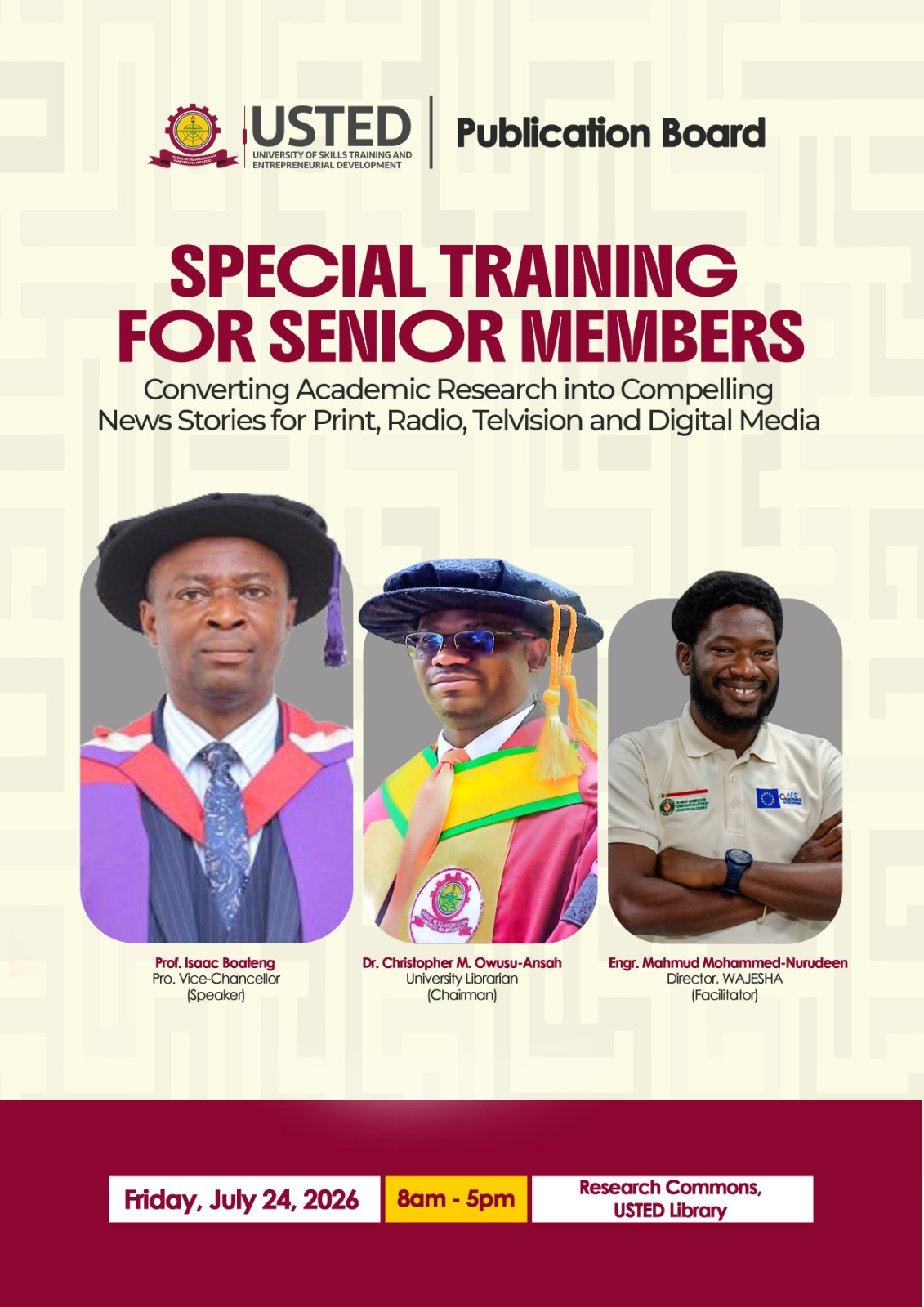
The West African Journalists for Environment, Science, Health and Agriculture (WAJESHA) is set to deliver a specialised training programme for senior members of the University of Skills Training and Entrepreneurial Development (USTED), aimed at helping researchers transform academic findings into compelling stories for print, radio, television and digital media.
Led by WAJESHA Director Engr. Mahmud Mohammed-Nurudeen and a team of experienced facilitators, the training will equip academics and researchers with practical storytelling and media engagement skills to communicate complex research in ways that are accessible, engaging and impactful.
The programme seeks to bridge the gap between research and journalism by enabling participants to present evidence-based findings that can better inform policymakers, industry, development partners and the wider public.
Through interactive sessions, participants will explore techniques for identifying newsworthy research, simplifying technical information, developing strong story angles, engaging with journalists and using multimedia platforms to broaden the reach and impact of their work.
WAJESHA, a non-profit journalism initiative of the Centre for Climate Change & Food Security (CCCFS), continues to champion quality reporting on environment, science, health and agriculture while supporting institutions to make research more relevant to society.
The organisation says strengthening communication between researchers and the media is essential to ensuring that scientific evidence contributes meaningfully to public discourse, policy development and sustainable development across West Africa.
WAJESHA expressed its appreciation to USTED for the opportunity to collaborate on the initiative and reaffirmed its commitment to promoting knowledge sharing and evidence-based communication.
Training Details
Time: 8:00 a.m.-5:00 p.m.
Date: Friday, 24 July 2026
Venue: Research Commons, USTED Library
The training forms part of WAJESHA’s broader mission to strengthen specialised journalism and improve public understanding of research that addresses critical environmental, scientific, health and agricultural challenges across the region.
By Peter Quao Adattor/paqmediagh