

Lawal Fuseini seeks investigations into the use of foreign-based radiologists, patient consent, professional registration and tax compliance at Accra Medical Centre, Sunshine Healthcare and Medylife Healthcare.
An independent public-interest investigator has petitioned Ghana’s health regulators to investigate the reported use of foreign-based radiologists by three healthcare facilities, raising questions about professional accountability, patient privacy and the handling of sensitive medical information.
Lawal Fuseini is asking the Medical and Dental Council (MDC) and the Health Facilities Regulatory Agency (HeFRA) to examine radiology reports allegedly issued for patients in Ghana by practitioners based in India. He is also seeking a tax-compliance investigation by the Ghana Revenue Authority (GRA) into payments reportedly made to foreign-based radiologists and related service providers.
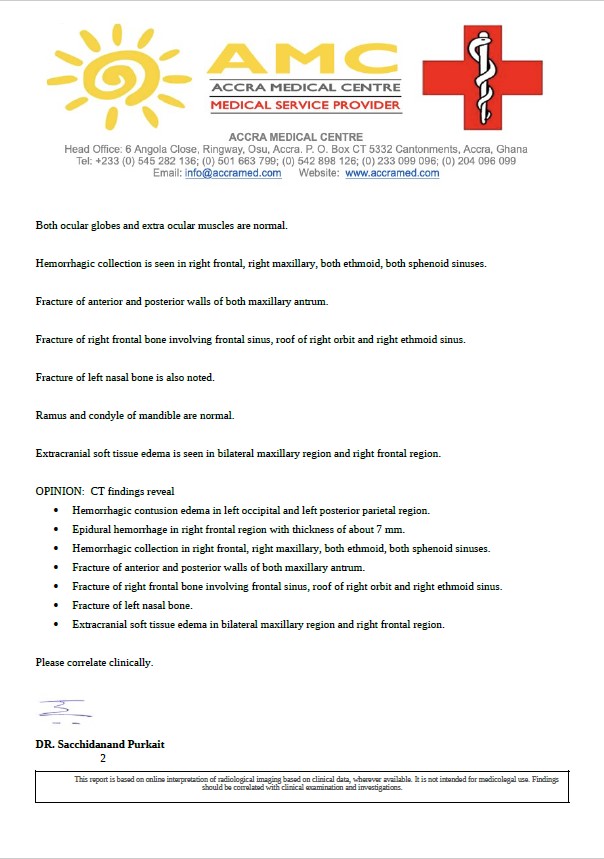
The petitions name Accra Medical Centre (AMC), Sunshine Healthcare Centre and Medylife Healthcare. They allege that some diagnostic reports were issued under the letterheads of Ghanaian facilities but signed by radiologists who were not registered with the Medical and Dental Council at the time the services were provided.
The allegations have not been independently established as regulatory breaches, and the petitions seek formal investigations to determine whether the arrangements comply with Ghanaian law and professional requirements.
Reports signed by foreign-based radiologists
According to documents cited in the petitions, the investigator identified several diagnostic reports bearing the names and professional details of practitioners he believes are based in India.
The reports he listed include:
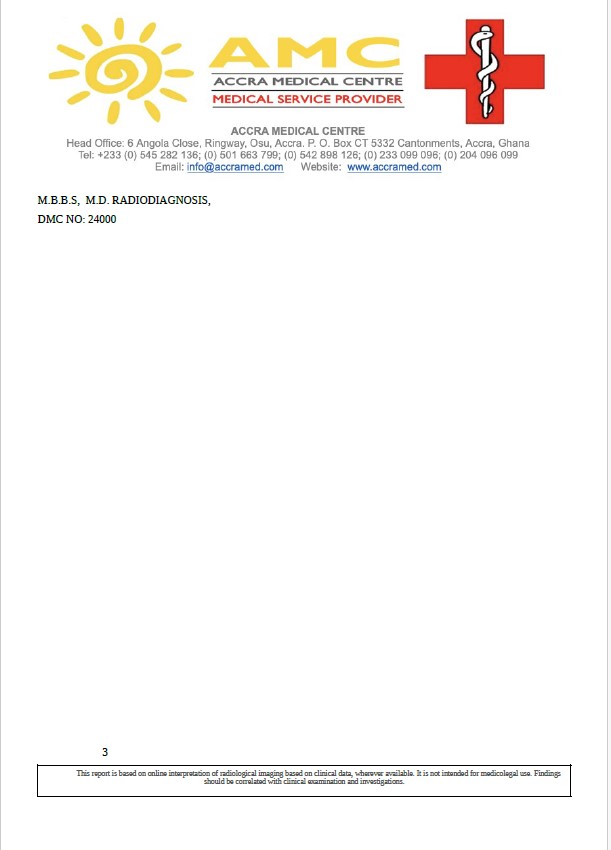
- Accra Medical Centre: Four reports attributed to Dr Nitij Gupta, two attributed to Dr Bhavesh Patel, and one attributed to Dr Sacchidanad Purkait.
- Sunshine Healthcare Centre: Four reports attributed to Dr Bhavesh Patel.
- Medylife Healthcare: One report bearing the name of Dr Venkatesan M, which the investigator says was associated with the facility but was not issued on its letterhead.
Fuseini alleges that the identified practitioners were not employees of the Ghanaian facilities and questions the professional and contractual arrangements under which they reportedly interpreted medical images and issued diagnostic reports.
He is asking the Medical and Dental Council to verify the practitioners’ registration status during the relevant periods and determine whether the reporting arrangements required registration or other authorisation under Ghanaian law.
The Council’s published mandate includes maintaining registers of practitioners qualified to practise medicine and dentistry in Ghana. Its registration framework also provides for temporary registration in certain circumstances involving foreign-trained practitioners. Whether any such provision applies to the arrangements described in the petitions is a matter for regulatory determination. https://www.mdc.gov.gh/register (Medical and Dental Council registration framework).
Questions over professional accountability
One of the central concerns raised in the petitions is who bears professional responsibility when a radiology report is issued in Ghana by a facility but interpreted and signed by a practitioner located outside the country.
Fuseini alleges that some reports examined during his investigation carried disclaimers stating that they had no legal value, despite appearing on the letterheads of the facilities concerned.
He is asking the Medical and Dental Council to establish whether the reports meet applicable professional standards, who is accountable for their clinical conclusions and what mechanisms patients have to seek clarification or challenge a report.
The petitions also ask whether the facilities have appropriate quality-assurance procedures, clinical-governance arrangements and systems for handling patient complaints where the reporting radiologist is based abroad.
The investigator further alleges that some patients were not adequately informed that their diagnostic images would be sent outside Ghana for interpretation.
He says undercover patient experiences formed part of his investigation and that, in the cases examined, he was not provided with information or asked to give specific informed consent for the transmission of medical images abroad.
The allegation raises questions about what patients are told about the processing and disclosure of their medical information, who receives the images, and whether adequate safeguards are in place.
Patient privacy and cross-border data transfers
Medical imaging can reveal sensitive information about a person’s physical condition. The transfer of identifiable scans and associated patient details to another country therefore raises important questions about privacy, data security, retention and access.
Ghana’s Data Protection Act, 2012 (Act 843), establishes a framework governing the collection, use and disclosure of personal information. It also classifies information relating to an individual’s physical or mental health as special personal data. https://ghalii.org/akn/gh/act/2012/843/eng%402012-05-18 (Read the Data Protection Act, 2012).
The investigator wants regulators to establish whether the facilities disclosed the relevant arrangements to patients, whether appropriate legal grounds and safeguards existed for the processing of their information, and whether any third-party technology platform or intermediary was involved in receiving, transmitting or storing the images.
The petitions do not establish that every transfer of medical images abroad is unlawful. Rather, they call for the relevant authorities to determine whether the specific arrangements complied with applicable requirements.
HeFRA urged to inspect facilities
In a separate petition, Fuseini has asked HeFRA to inspect the diagnostic-imaging operations of the three facilities and review their staffing records, contracts, reporting workflows, licensing conditions and quality-control procedures.
He wants the Agency to establish whether the facilities declared the foreign-based practitioners as part of their professional arrangements, whether the use of such reporting services was disclosed to the regulator, and whether the facilities’ licences and operational requirements cover the services being provided.
HeFRA’s mandate includes licensing health facilities, inspecting their operations and monitoring the adequacy and standard of healthcare delivery. Its published licensing requirements also refer to certificates of proposed practitioners and evidence of current registration with the appropriate professional bodies. https://hefra.gov.gh/ (Health Facilities Regulatory Agency).
The petitions also ask HeFRA to investigate a separate concern raised by patients about a person identified as Sebin Sebastian, whom Fuseini alleges was working as a radiographer at Accra Medical Centre without the necessary qualifications or registration.
The investigator wants the Agency to verify whether Sebastian works or worked at the facility and establish his professional qualifications and registration status. That allegation also requires independent verification.
GRA asked to examine payments to foreign providers
The third strand of the complaint concerns payments allegedly made by Ghanaian diagnostic facilities to radiologists and other professional service providers based outside the country.
Fuseini is asking the Ghana Revenue Authority to examine whether such payments were properly documented and declared, and whether applicable tax obligations were met.
The proposed tax investigation is separate from the questions of professional registration and facility licensing. The fact that a service provider is based abroad does not, by itself, establish that a tax offence has occurred. The relevant payment arrangements, contractual relationships and applicable tax rules would need to be examined.
Ghana’s health-data sovereignty debate
The petitions also place the issue within Ghana’s wider debate about the protection of sensitive health information.
Fuseini refers to the government’s decision not to proceed with a proposed United States health compact amid concerns over provisions involving access to sensitive health information, including medical records.
He argues that the concerns raised in that debate make it important to examine how private healthcare facilities protect patient information when it is transmitted to practitioners outside Ghana.
The comparison raises a broader policy question: what safeguards should apply whenever sensitive health information crosses national borders, whether through a government arrangement, a private healthcare provider or an outsourced diagnostic service?
What the investigator wants regulators to do
Across the petitions, Fuseini is seeking formal investigations, verification of the named practitioners’ professional status, inspections of the facilities’ relevant operations and a determination of whether the arrangements complied with applicable laws, licensing conditions and professional standards.
He has indicated that he is prepared to provide copies of the radiology reports, correspondence, responses to requests made under the Right to Information framework, patient documentation and other material he says is available to support the complaints.
He has also requested written responses setting out the regulators’ findings and any action considered necessary.
The healthcare facilities and practitioners named in the petitions should be allowed to respond to the allegations. Their responses, along with the findings of the relevant regulators, will be important in establishing the facts.
For patients, the central issue is straightforward: they should be able to understand who is interpreting their medical images, who is responsible for the resulting report and how their confidential health information is protected.
The outcome of the proposed investigations could help clarify the regulatory expectations for outsourced and cross-border radiology reporting in Ghana, and whether existing safeguards adequately protect patients.
By Peter Quao Adattor/paqmediagh