
OECS Demands Overhaul of Biodiversity Financing at Launch of Commonwealth Nature Initiative

November 16, 2026 – The Organisation of Eastern Caribbean States (OECS) has called for systemic reform to make biodiversity financing more accessible, predictable and timely for small island nations.
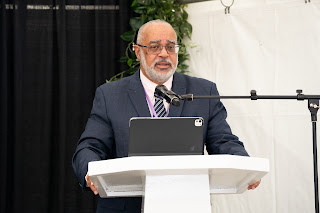
OECS Director General Dr Didacus Jules made the call at the high-level launch of the Commonwealth Nature Initiative (CNI) on November 2, 2026. The event was held aboard Fortescue’s Green Pioneer in St. John’s, on the sidelines of the 28th Commonwealth Heads of Government Meeting (CHOGM). Antigua and Barbuda’s Prime Minister, Gaston Browne, convened it.
Dr Jules said reform is needed to close the gap between global commitments and national action. For Small Island Developing States, he said, protecting biodiversity underpins food security, climate resilience, livelihoods and economic prosperity.
The meeting brought together heads of government, ministers, Commonwealth officials, philanthropists and conservation groups. They aim to protect at least 30 per cent of the world’s land and ocean by 2030.
The OECS 30×30 Transformation Programme
The programme is one of three founding regional programmes of the CNI, alongside the Africa Keystone Protected Area Partnership and the Unlocking Blue Pacific Prosperity initiative.
All 12 OECS member states worked together to set the regional 30×30 goals and funding needs, totalling US$200 million by 2030. The funding will implement the Kunming-Montreal Global Biodiversity Framework across nine priority themes:
– Marine and coastal conservation (US$130-140 million): Protecting about 8 million additional hectares of marine and coastal ecosystems to reach the 30 per cent threshold, with better management and more restoration capacity in every member state.
– Protected area management and ecosystem resilience (US$20-30 million): Strict protection for all Key Biodiversity Areas, and about 10,000 hectares of forest and watershed ecosystems restored, drawn from 17,900 hectares of restorable habitat identified.
– Integrated land-use planning (US$20-30 million): Less conflict between development and conservation, better ecological connectivity across islands, and biodiversity built into national planning systems.
– Regional Conservation Hub (US$1-2 million): A permanent regional mechanism to coordinate implementation, mobilise finance and support member states.
– Regional Green Bond (US$1-2 million, programme development): A replicable platform to mobilise tens of millions in new financing, roughly ten times the development cost.
– Sustainable Finance Roadmap and Centre of Excellence (US$1-2 million): Lasting regional capacity to mobilise the full US$200 million and reduce reliance on short-term donor projects.
– Sargassum Regional Strategy (US$2-3 million): A regional system able to process up to 100,000 tonnes of sargassum a year.
– Biodiversity enhancement in food systems (US$3-4 million): Higher agricultural productivity, stronger soil and watershed resilience, more nature-positive value chains and less dependence on food imports.
– Nature-based tourism (up to US$1 million): An estimated 20 per cent rise in visitor spending, stronger community benefits and sustained financing for protected areas.
A Call to Partners
Dr Jules said the region has the ambition, political commitment and regional mechanisms to deliver 30×30. What it needs is financing that is accessible, predictable and catalytic, along with suitable technical support.
He said the OECS is ready to work with the Commonwealth, member states, financial institutions, philanthropy and the private sector, in line with the vision of COP 17 of the Convention on Biological Diversity, recently held in Armenia.
Partners interested in specific projects under each theme are invited to engage directly with the OECS Commission.
The CNI mobilises governments, philanthropy and business to fund national and regional 30×30 programmes in middle- and low-income Commonwealth countries, with funding flowing directly to those programmes. Antigua and Barbuda, the Commonwealth Secretariat, Minderoo Foundation, the Rob Walton Foundation, Campaign for Nature, National Geographic Pristine Seas and Dynamic Planet developed it.
Source: OECS Media Release, November 16, 2026, and OECS 30×30 programme document