

Beyond his distinguished traditional leadership, the late Paramount Chief of the Agogo Traditional Area, Nana Kwame Akuoko Sarpong, leaves behind a remarkable legacy of forest conservation, land restoration and sustainable development.
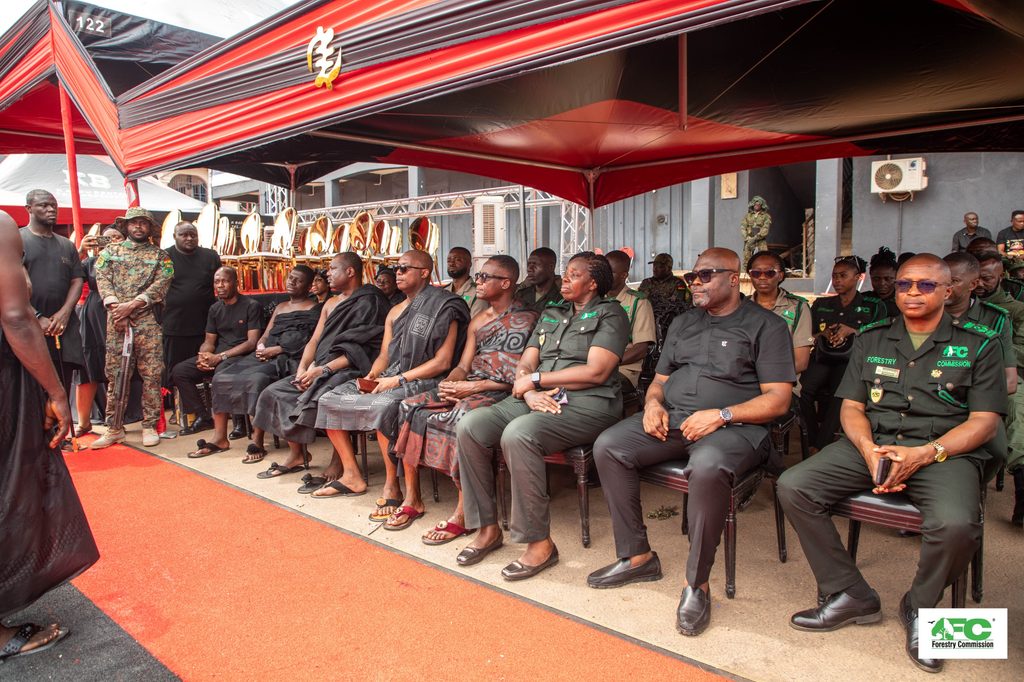
The Forestry Commission on Tuesday joined thousands of mourners at Agogo in the Ashanti Region to pay its last respects to the late traditional ruler, whose decades-long partnership with the Commission contributed significantly to forest restoration and plantation development.
The Chief Executive of the Forestry Commission, Dr Hugh Brown, led a high-powered delegation to commiserate with the Agogo Traditional Council, the bereaved family and the people of Agogo on the first day of the three-day burial programme, traditionally known as Dote Yie.
As part of its contribution towards the funeral, the Commission presented two bottles of schnapps, a box of Black Label whisky and an undisclosed amount of money.
A Traditional Ruler Who Turned Degraded Lands into Productive Forests
According to the Forestry Commission, the late Omanhene was more than a traditional ruler. He was a strategic partner in forest conservation and environmental sustainability.
His relationship with the Commission dates back to 1985, when he obtained permission to reclaim degraded forest lands within the Agogo Traditional Area.
He was subsequently allocated 689.78 hectares of degraded land within the Bandai Hills Forest Reserve for forest plantation development.
Through an innovative agroforestry system, Nana Akuoko Sarpong intercropped young teak trees with plantain, demonstrating how forest restoration could coexist with agricultural production and economic development.
The success of the initiative earned him the National Best Plantain Farmer Award in 2008 and contributed to the expansion of plantain production in Agogo.
His initiative demonstrated the potential of agroforestry to restore degraded landscapes, support agricultural productivity and create economic opportunities without compromising environmental sustainability.
Championing the Restoration of Over 20,000 Hectares of Degraded Forest Lands
As a traditional ruler, landowner and custodian of significant forest resources, Nana Akuoko Sarpong worked closely with the Forestry Commission on land rights, forest protection, plantation development and responsible timber harvesting.
According to the Commission, his interventions reflected transparency, accountability and a strong conviction that traditional authorities are indispensable partners in sustainable forest governance.
The late Agogomanhene strongly supported efforts to rehabilitate degraded lands within the Oyimso, Bandai Hills and North Bandai Hills forest reserves in the Juaso Forest District, as well as the Boumfum Forest Reserve in the Kumawu Forest District.
As the traditional overlord of Agogo, he provided a favourable operational environment and landowner support to private developers engaged in commercial forest plantation development.
Through public-private partnership arrangements, companies including EcoPlanet Bamboo, Miro Forestry Ghana Limited and 26 other local companies are undertaking reforestation activities covering more than 20,000 hectares of degraded lands within these forest reserves.
His support for these initiatives underscores the important role traditional authorities can play in reversing forest degradation, restoring ecosystems and promoting sustainable land use.
A Legacy of Environmental Stewardship
At a time when Ghana continues to grapple with deforestation, illegal mining, biodiversity loss and widespread land degradation, the late Agogomanhene’s commitment to forest restoration offers valuable lessons in traditional leadership and environmental stewardship.
The Forestry Commission described his legacy as a testament to the importance of collaboration between traditional authorities, local communities, private sector actors and state institutions in protecting Ghana’s natural resources.
His decades of collaboration with the Commission also demonstrate how traditional leadership can help mobilise investment, facilitate land restoration and advance sustainable forest management.

Forestry Commission Pays Its Last Respects
The delegation accompanying Dr Hugh Brown included the Ashanti Regional Manager of the Forest Services Division (FSD), Mr Noble Isaac Eshun; Director of the Resource Management Support Centre (RMSC), Mr Yaw Atuahene Nyako; Director of Operations, Plantations, FSD, Mrs Valerie Fumey-Nassah; and Director of Operations, Natural Forest, FSD, Mr Yaw Kwakye.
Others were the Head of Corporate Affairs and Media Relations Unit, Mrs Joyce Ofori Kwafo; District Managers of the Juaso and Kumawu Forest Districts; forest guards and other officers of the Commission.
They joined traditional authorities, the bereaved family and thousands of mourners to bid farewell to the late traditional ruler.
While Nana Kwame Akuoko Sarpong’s passing marks the end of an era of traditional leadership, his contributions to forest restoration and sustainable development remain a lasting legacy.
Beyond the palace and the stool, his legacy lives on in the forests he helped restore and the partnerships he championed to protect Ghana’s natural heritage.
By Peter Quao Adattor/paqmediagh