
The Minister of Health, Kwabena Mintah Akandoh, has directed an urgent investigation into the circumstances under which a hit-and-run victim was denied emergency care by three major hospitals in Accra for nearly three hours before he died.
The directive follows public outrage over the incident, which has once again brought Ghana’s long-standing “no bed syndrome” into sharp national focus.
A Night That Became a Tragedy
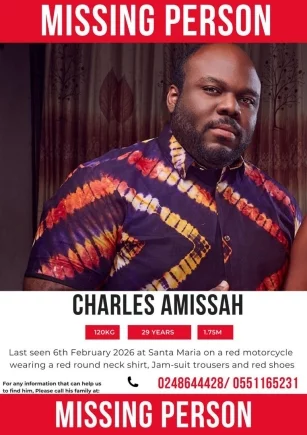
The victim, 29-year-old Charles Amissah, an engineer with Promasidor Ghana Limited, was knocked down in a hit-and-run incident near the Nkrumah Circle Overpass late on the night of Friday, February 6, 2026.
Emergency Medical Technicians (EMTs) from the National Ambulance Service received a distress call at about 10:32 pm and arrived at the scene within minutes. The victim was stabilised in the ambulance, placed on oxygen, and continuously monitored as efforts were made to secure emergency admission at a hospital.
What followed, according to situational reports, was a desperate and fruitless journey across Accra’s major health facilities.

Three Hospitals, One Response: “No Bed”
The ambulance team first proceeded to the Police Hospital, then the Greater Accra Regional Hospital (Ridge), and finally the Korle Bu Teaching Hospital.
At each facility, the response was the same: no available bed space.
Despite repeated pleas from the EMTs to either admit the patient or render emergency care inside the ambulance, no medical officer attended to him at any of the three hospitals. At Korle Bu, the ambulance crew reportedly spent more than 30 minutes negotiating, warning that further movement could worsen the patient’s condition.
Instead, they were advised to continue transporting him to another facility.
Before that could happen, the victim’s condition deteriorated. He later went into cardiac arrest inside the ambulance. Resuscitation efforts were unsuccessful, and he was eventually pronounced dead.
Family Learns Days Later
Tragically, Charles Amissah’s family only began searching for him after he failed to return home to Adenta that night. He was declared missing, and posters were circulated on social media.
It was three days later, on Monday, February 9, that police informed the family that their missing relative had died and his body was at the Korle Bu mortuary.
Minister Demands Answers
Reacting to the public outcry, the Health Minister has directed that a full investigation be conducted into the conduct of all the hospitals involved, the adherence to emergency care protocols, and the systemic failures that led to the denial of treatment.
The findings, according to sources at the Ministry of Health, are expected to guide sanctions, reforms, and policy decisions to prevent a recurrence.
A System Under Scrutiny
The incident has reignited debate about emergency healthcare delivery in Ghana, particularly the obligation of hospitals to provide life-saving first response care, regardless of bed availability.
As the investigation begins, many are asking a painful question:
How many more lives must be lost before “no bed syndrome” stops becoming a death sentence?
For the family of Charles Amissah, the probe may bring answers, but it cannot bring back a son who spent his final hours driving from hospital to hospital, searching for help that never came.
Source: paqmediagh/Peter Quao Adattor