

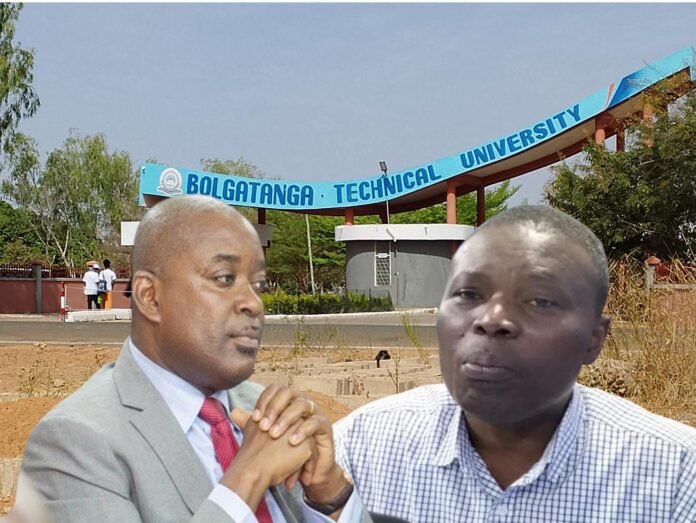
As widely anticipated by sections of staff and stakeholders, the Vice-Chancellor (VC) of Bolgatanga Technical University (BTU) has reportedly sought intervention from the Ghana Tertiary Education Commission (GTEC) following a directive by the BTU Governing Council that he proceed on his accumulated annual leave.
This directive was issued while Council undertook steps to address long-standing governance, administrative, and community-relations challenges that have emerged under his tenure.
Petitions and Stakeholder Concerns
In recent months, the BTU Governing Council received numerous petitions from diverse stakeholders, including:
- University staff;
- Concerned citizens within the Upper East Region;
- The Sumbrungu Community, within which the University is located; and
- The Bolgatanga Traditional Council.
These petitions alleged, among other things, breaches of the University’s Statutes, persistent disregard for established administrative procedures, and a lack of respect for traditional authorities and host communities.
Alleged Administrative and Statutory Breaches
The petitions and related complaints raised several key issues, including allegations that the VC:
- Flouted established promotion and appointment procedures, despite having personally benefited from such processes in the past;
- Denied eligible staff their rightful promotions, and in some cases, allegedly downgraded staff members;
- Refused to grant post-retirement rollovers to qualified staff, contrary to the University’s Conditions of Service;
- Arbitrarily appointed junior staff to headship positions over more senior and qualified officers, in violation of the Scheme of Service and the BTU Statutes.
Additionally, concerns were raised regarding the VC’s appointment in 2021. It is alleged that the previous Governing Council sidestepped the BTU Statutes in appointing him, despite claims that he did not attain the required pass mark in the selection process and was outperformed by another candidate.
Committee of Inquiry and Its Recommendations
In response to the growing number of petitions from university staff, concerned citizens, the Sumbrungu Community, and the Bolgatanga Traditional Council, the BTU Governing Council constituted a committee to investigate allegations of administrative misconduct and strained community relations involving the Vice-Chancellor (VC).
According to reports of the committee’s findings, a major conclusion was that the relationship between the VC and the immediate host communities, particularly the Sumbrungu Community and the Bolgatanga Traditional Council, had become severely strained and toxic, posing risks to institutional harmony and personal safety.
The committee reportedly recommended that:
- Council should lead a structured reconciliation and appeasement process between the University and the affected traditional authorities and communities;
- The VC should not be directly involved in this reconciliation process, given the depth of hostility and the assessment that his continued presence posed potential security risks to his own safety.
Council’s Decision and Staff Response
Based on the committee’s recommendations, the Governing Council resolved that the VC should proceed on his accumulated annual leave while Council undertook the reconciliation process and addressed the outstanding governance concerns. This decision was reportedly well received by staff, who viewed it as being in the broader interest of institutional stability, student welfare, staff morale, and the personal safety of the VC.
Community Opposition
The Sumbrungu Community, through its representatives and committees, has openly expressed strong opposition to the VC’s continued presence, citing alleged disrespect toward community elders and traditional leaders. Petitions from the community reportedly stated that peaceful coexistence with the VC had become untenable under the prevailing circumstances.
GTEC Intervention and Governance Concerns
Despite the Council’s directive, the VC is reported to have sought refuge at GTEC, requesting the Commission’s intervention to halt the Council’s decision. Critics argue that this move represents an overreach, as GTEC’s mandate under the Education Regulatory Bodies Act, 2020 (Act 1023), is regulatory rather than executive.
Under the prevailing legal and statutory framework:
- Executive authority over public universities is vested in the President of the Republic and exercised through duly constituted Governing Councils;
- University Councils, therefore, retain the authority to direct administrative actions such as requiring a Vice-Chancellor to proceed on leave.
- On this basis, critics contend that GTEC lacks the legal power to direct the BTU Council to stay its decision.
Allegations of Political Influence and Abuse of Regulatory Processes
It is further alleged that the VC has, over the years, leveraged GTEC processes to pursue personal interests and vendettas against certain staff members. There are also claims that political actors were engaged to influence the situation, including correspondence allegedly issued to the University based on unverified claims rather than facts.
Conclusion
At the heart of the controversy are fundamental questions of university governance, statutory authority, respect for host communities, and the proper limits of regulatory intervention.
Stakeholders continue to call for strict adherence to the BTU Statutes, respect for traditional authorities, protection of staff rights, and the preservation of institutional autonomy through lawful and transparent decision-making by the Governing Council.
Viewpoint written by Julius Banera, a community development consultant. Email: barjuli44@gmail.com
Source: Media Without Borders/mwbonline.org/Ghana/West Africa