

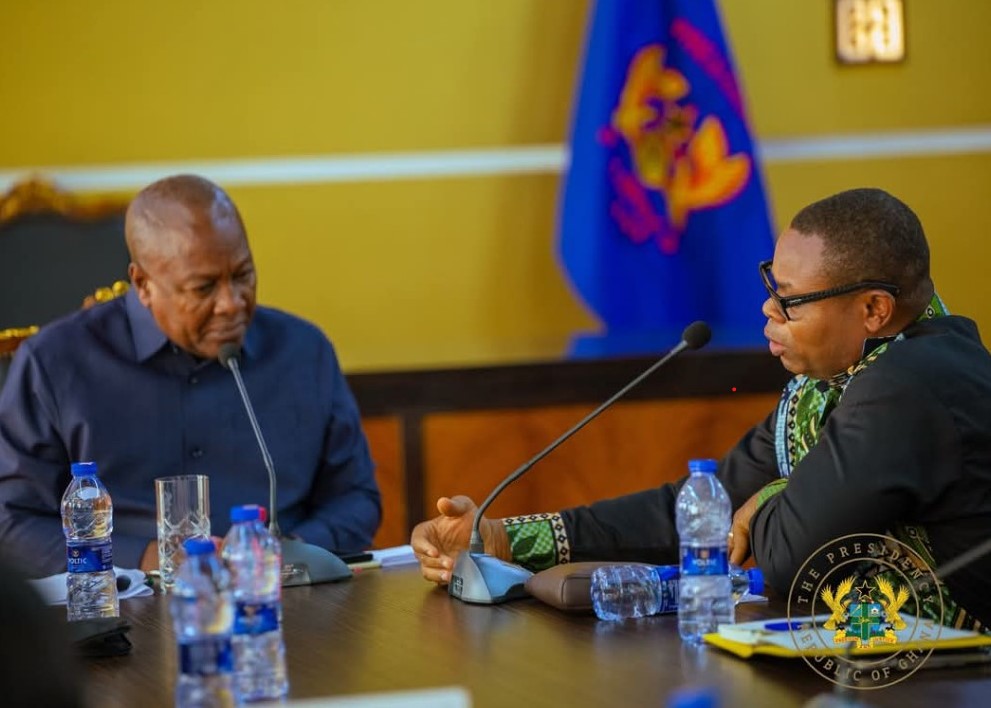
The meeting was held at the invitation of the President, who sought IMANI’s independent assessment of the emerging policy framework. IMANI welcomed the engagement as an opportunity to present evidence-based concerns and to contribute constructively to national decision-making on a matter of long-term strategic significance.
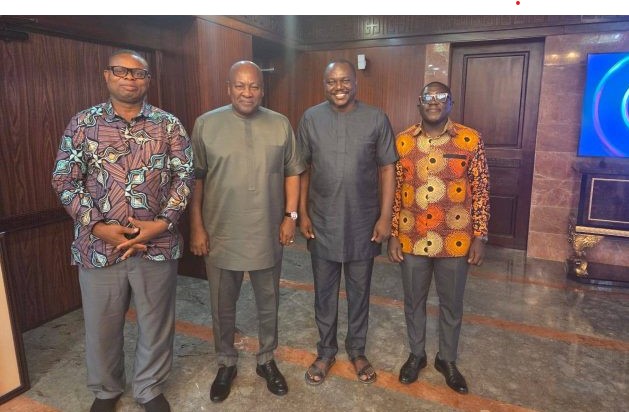
IMANI’s Position and Issues Raised
During the meeting, IMANI reiterated its long-standing view that the governance of Ghana’s minerals must be grounded in transparency, fiscal prudence, and clear public accountability. IMANI highlighted persistent gaps in valuation methods, clarity of fiscal terms, regulatory oversight, and the structure of state participation.
The discussion was frank and focused, with the President expressing interest in receiving a formal and comprehensive briefing on IMANI’s full assessment of the proposed lithium framework, which was submitted on Monday, 8th December 2025
Read our Policy Position
IMANI’s Earlier Publications on the Lithium Agreement
IMANI’s engagement on this matter builds on a series of earlier publications, analyses, and public commentary issued over the past year. These works raised concerns about:
- The absence of a transparent valuation of Ghana’s lithium assets.
- Ambiguities in the revenue-sharing structure and long-term fiscal benefits.
- Weaknesses in the regulatory and environmental oversight regime.
- The lack of alignment with global best practices for green mineral management.
- Potential risks of replicating historical shortcomings in Ghana’s extractive governance.
IMANI’s publications also emphasised the need for a coherent national strategy for green minerals, especially as Ghana seeks to position itself in the global energy transition.
Policy Position Submitted to the Presidency
Following the engagement, IMANI submitted a detailed Policy Position to the Presidency. The document consolidates IMANI’s previous analyses, incorporates updated findings, and outlines critical policy, governance, and economic issues associated with the lithium agreement.
The Policy Position also includes specific recommendations intended to help Ghana secure maximum long-term value from its lithium deposits, ensure transparent regulatory processes, and strengthen public trust in natural resource governance.
IMANI remains committed to offering rigorous, non-partisan research support to national institutions and to safeguarding the public interest through evidence-based policy advocacy.
Earlier Publications on the Lithium Agreement
- IMANI on the Atlantic Lithium Deal
- Why Ghana’s First Lithium Agreement shouldn’t be Ratified as is
- The Atlantic Lithium (Ewoyaa Project) Deal: Why Ghana’s Parliament Should Not Ratify a Flawed Agreement
- The Atlantic Lithium Puzzle: Why Ghana Is Giving Away More for Less
- IMANI’s Public Statement on the Revised Ewoyaa Lithium Mining Lease Urging Parliament NOT to Ratify the Barari DV (Atlantic Lithium) Agreement in its Current Form
Below is a conversation between IMANI’s Founding President, Franklin Cudjoe, and Vice-President Bright Simons on the government’s plan for a lithium deal that would be worse than that of the past government.
Franklin Cudjoe (FC): The government, through the Minister, Hon. Buah, has expressed concern that the lithium project might not be viable for the investor. What is your response to this concern, and why is financial modelling so central to this debate?
Bright Simons: Initially, the government, through the Minister, Hon. Buah, expressed concern that the project might not be viable for the investor. If the project is not viable for the investor, it simply will not happen. No jobs will be created, the mine will not operate, and the country gains nothing. But you cannot make such an assessment without starting with a detailed financial model of the project.
So far, only the investor has produced a financial model through the Definitive Feasibility Study (DFS). Ghana does not have its own independent financial model. As a result, we all rely solely on the investor’s DFS, and that is not ideal for national decision-making.
FC: Critics, including IMANI, have called for greater scrutiny. What is your position on collaborating to build a shared financial model for the project? And what key factors, such as lithium price forecasts, must the model consider?
Bright Simons: IMANI and other think tanks are more than willing to work with the government’s technical team to develop a common financial model. That way, all parties can use the same assumptions and parameters when explaining the project to the public.
We are also open to working together to produce an enhanced model, one that incorporates not only the investor’s DFS perspective but also additional factors the investor may not have considered, such as the benefits to host communities.
A comprehensive financial model is essential. Lithium prices fluctuate widely. You cannot use today’s price to make a 12-year investment decision. What matters is the projected average price over the mine’s 12-year life. In the investor’s own model, the average price over the period is US$1,587. Today, the price is around US$1,100–1,200, slightly below that long-term average. But lithium prices have recently moved from below US$800 to US$1,200, a nearly 50% jump in a short time. Prices will fluctuate; what matters is the long-term average.
Global demand for lithium will increase due to battery manufacturing. Historically, as demand grows, prices rise. So, no one can claim that today’s price will remain the same for the next 12 years. This is why a solid financial model, not guesswork, must guide national decision-making.
FC: Given current lithium prices and the company’s reported production costs, they appear to have a healthy gross margin. On what financial basis, then, is the investor requesting additional fiscal concessions or tax relief from the state?
Bright Simons: If we analyse their own numbers, the company intends to use Dense Media Separation (DMS), which is relatively cheap, and they can do so because the ore grade is very high. The company itself states that its average production cost is about US$610 per tonne.
Even though production costs fluctuate, this average gives us a clear picture. At today’s prices, their gross margin is about 45%. Many Ghanaian businesses, including telecom companies, operate with far lower margins and still thrive. If every company with margins below 45% requested tax concessions, the economy would collapse.
So, on what basis does a company with a 45% margin claim the project is not viable?
Under the previous government, lithium prices were about US$800, and their gross margin was under 20%, yet they were still seeking approval. Today, when margins are higher, they claim the project is not viable unless they get additional concessions. This is inconsistent.
Moreover, their original model assumed an almost 70% gross margin, expecting to sell lithium at around US$1,600 with production costs near US$600. That means they expected to recover their initial investment in just 19 months. Even if prices shift slightly and recovery takes three years, it is still extremely attractive.
If any Ghanaian investor could recover a US$200 million investment in under two years, everyone would be in business.
So, based on the company’s own DFS figures, there is no justification for additional concessions. If they disagree, we are ready to perform a joint financial modelling exercise and accept the results. But based on the current numbers, the request for concessions is unjustified.
FC: There seems to be public confusion about which mining law applies: the 2006 law, Act 794 of 2010, or Act 900 of 2015. Can you clarify the legal situation regarding royalty rates and where the authority to set them lies?
Bright Simons: The legal situation is actually straightforward. There was a mining law in 2006, which introduced a sliding-scale royalty of about 3–5%. That law was replaced in 2010 by Act 794, which fixed royalties at 5%. Government officials continue to quote the 2010 law.
However, in 2015, Act 900 was passed. Act 900 supersedes the 2010 law and shifts the power to set royalty rates from the main law to regulation. In Ghana, regulations are made through Legislative Instruments (LIs). Only the Minister can create an LI. Parliament cannot amend it; it can only reject it. If Parliament does not reject it within 21 days, it automatically becomes law. This means the Minister can set different royalty rates for specific minerals, including lithium, by simply issuing a Legislative Instrument under Act 900. He could set the lithium royalty at 10% tomorrow, and it would take effect in three weeks. There is nothing in the law preventing this. So, the notion that the Minister’s hands are tied is incorrect.
FC: You argue that critical or “green” minerals like lithium require a different regulatory approach from traditional minerals like gold. Why, and what mechanism should the government use?
Bright Simons: We are calling for the publication and consultation of a green minerals policy to separate traditional minerals from critical, fast-changing ones like lithium. Traditional minerals such as gold, silver, and iron have mature markets with relatively stable volumes and predictable prices. In contrast, new green minerals face rapid, volatile demand shifts. Prices can jump a hundredfold in months, as happened when lithium carbonate hit US$100,000.
If Ghana uses the same royalty system for lithium as for gold, we risk locking ourselves into outdated terms while investors reap enormous windfall profits. This is precisely why Act 900’s regulatory mechanism is powerful. It enables the Minister to set special royalty rules tailored to critical minerals, quickly and flexibly. The government should use this mechanism and work with civil society on a proper green minerals framework.
FC: Local value addition is a major point of contention, especially regarding building a refinery. What is wrong with using a “scoping study” as the agreement proposes, and what exactly are you demanding to ensure Ghana refines its lithium into higher-value products?
Bright Simons: Refining is crucial because the value of processed lithium, such as lithium hydroxide or lithium carbonate, can be up to 20 times higher than raw ore. We cannot repeat the global mistake where China controls not only mining but also almost all processing, which gives them massive strategic power.
The current agreement only commits to a scoping study, which merely explores whether further study is needed. That is too weak.
We are demanding a full feasibility study, completed within the first year. A feasibility study tells us:
Since everyone agrees that Ghana must not continue exporting raw lithium, the scoping study approach is inadequate. We want a binding commitment to a feasibility study to guarantee real value addition and refinery development.
These are our three key demands:
Joint, credible financial modelling.
Use of Act 900’s regulatory power to set appropriate royalties for critical minerals.
A binding feasibility study, not a scoping study, for lithium refining.
FC: Thank you for your time
Source: IMANI Africa