

Still reeling from a painful electoral defeat, the New Patriotic Party (NPP) finds itself at a critical juncture. In an attempt to reassert relevance and rebuild internal cohesion, the party has scheduled an early presidential primary for January 31, to select a flagbearer for the 2028 presidential election.
Yet the atmosphere surrounding this internal democratic exercise has been anything but fraternal.
Rather than a contest of ideas pitched to the grassroots, where party creativity, renewal, and moral distinctiveness could be showcased, the process has degenerated into vicious personality attacks and a recriminatory blame game over the party’s loss in the 2024 general election.
Admittedly, electoral politics is rarely gentle. It is often bruising, as candidates court delegates and test loyalties. However, the level of vitriol on display has projected the NPP as deeply fragmented, struggling to present a united and disciplined front against a ruling National Democratic Congress (NDC) that currently enjoys broad public goodwill.
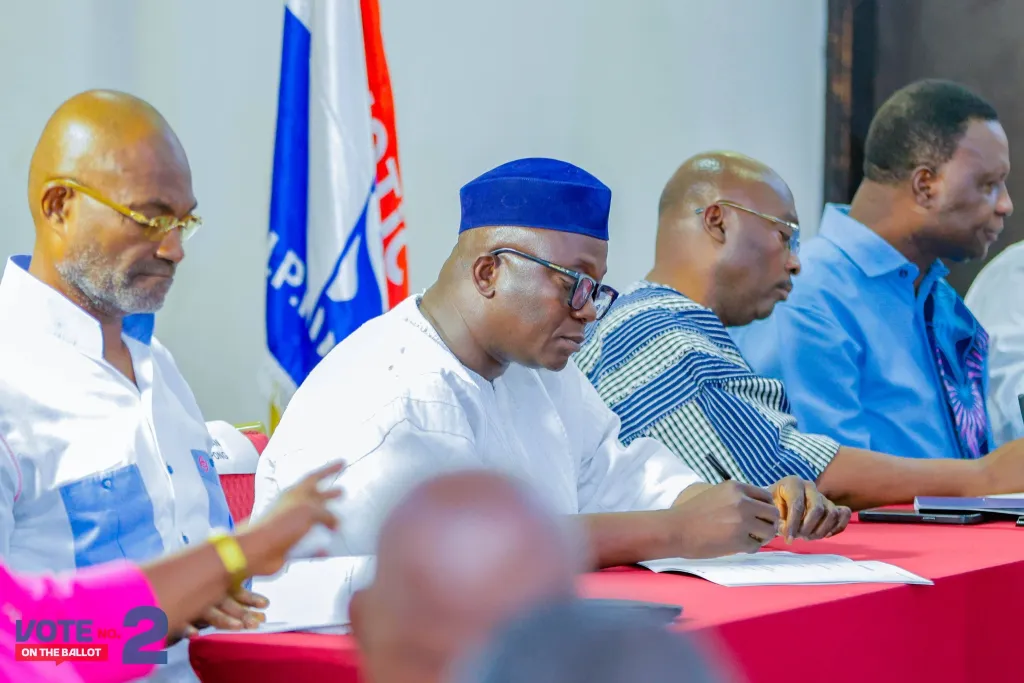
Unsurprisingly, this internal “cold war” among aspirants has triggered a familiar Ghanaian response: the signing of a Peace Pact.
While symbolically comforting, such ceremonies are often a tacit admission that something is fundamentally broken within the party’s internal democratic culture. This ritual is not unique to intra-party contests; it has become a fixture of national elections, where the National Peace Council routinely convenes presidential candidates to pledge non-violence.
But a fundamental question must be asked: what is the actual value of a non-binding commitment with no legal force?
Peace pacts have not prevented electoral violence.
Elections are not governed by handshakes, smiles, or staged displays of unity. They are governed by laws, rules, and enforceable procedures. Candidates do not need to “agree” to obey electoral rules; by choosing to participate, they automatically submit themselves to the legal framework that regulates the process. Violations already carry sanctions clearly provided for in law and party constitutions.
When we elevate ceremonial peace pacts above the rule of law, we implicitly concede two troubling realities.
First, we admit institutional fragility, that the Electoral Commission, the Police, the Judiciary, or internal party dispute-resolution mechanisms are too weak to guarantee free and fair elections without candidates’ consent.
Second, we elevate personality over institutions, suggesting that political actors wield more power than the systems they seek to govern—capable of either restraining or unleashing their supporters at will.
In truth, a peace pact is only as effective as the satisfaction of the losing side. Where a candidate believes the process has been unfair, they are entitled and obligated to seek redress through established legal channels. If an election is genuinely credible, a peace pact is redundant. If it is flawed, the pact risks becoming little more than a gag order.
The persistence of these rituals signals a deeper malaise. It communicates that our politics is inherently unstable and that respect for the rule of law is optional, contingent on informal, non-enforceable undertakings that dissolve the moment tensions rise.
What Ghana, and the NPP in particular, requires is not more signatures on symbolic agreements, but greater confidence in, and adherence to, the frameworks that already exist. Candidates must respect the rules not because they signed a pact, but because they respect the offices they seek to occupy. More importantly, institutions must act decisively, impartially, and without fear or favour, rendering peace pacts unnecessary.
As the NPP prepares to elect its next flagbearer, public attention should not be on optics, who smiled, who frowned, or who signed on behalf of whom, but on whether the party has faithfully complied with its own constitution and internal rules.
It is time to move beyond theatrical gestures and recommit to rules-based politics.
When peace is treated as a favour granted by politicians rather than an obligation imposed by law, the very foundations of democracy are weakened.
(IMANI – Critical Analysis of Governance Issues | January 19–24, 2026)