


For close to three agonising hours on the night of Friday, February 6, 2026, a young man clung to life inside an ambulance, moving from hospital to hospital across Accra, not because care was unavailable, but because no bed was vacant.
By the time help came, it was only to certify his death.
A Crash, a Swift Response, and a Long Wait
At 10:32 pm, Emergency Medical Technicians (EMTs) from the National Ambulance Service received a walk-in distress call reporting a road traffic crash at the Nkrumah Circle Overpass. Within three minutes, an ambulance was dispatched and arrived at the scene by 10:35 pm.
The victim, later identified as 29-year-old Charles Amissah, had been involved in a hit-and-run accident while riding his red motorcycle home to Adenta after closing from work at Promasidor Ghana Limited in Accra’s North Industrial Area.
According to a situational report (SITREP) available to Graphic Online, the EMTs immediately stabilised Charles at the scene:
- Bleeding was controlled with gauze bandages
- A cervical collar was applied
- He was log-rolled onto a spine board
- Oxygen therapy was initiated at 4 litres per minute
- Vital signs were monitored every five minutes
Initial assessment showed: BP: 120/90 mmHg, Pulse: 100 bpm, Respiratory rate: 25 bpm, SpO₂: 99%, and Temperature: 36.4°C. He was alive. He was stable. He needed emergency hospital care.
Three Hospitals, One Answer: “No Bed”
From that point until about 12:50 am, the ambulance crew engaged in what would become a fatal cycle of refusals.
Charles was first taken to the Police Hospital. He was not admitted. The reason given: no space.
The ambulance then proceeded to the Greater Accra Regional Hospital (Ridge). Again, he was refused admission.
The final stop was the Korle Bu Teaching Hospital, Ghana’s premier referral facility. There, the EMTs spent over 30 minutes negotiating, warning that the patient’s condition was deteriorating and that continued movement could endanger his life.
Despite these pleas, Charles was not admitted. No hospital staff attended to him. Hospital personnel did not take vital signs. The offer to manage him temporarily on the ambulance trolley was declined
Instead, the ambulance crew was advised to transport him to the University of Ghana Medical Centre (UGMC), another long journey.
Death Inside an Ambulance
Before that transfer could happen, Charles Amissah’s condition worsened. After nearly three hours of being shuttled between hospitals, he went into cardiac arrest inside the ambulance.
The EMTs immediately initiated cardiopulmonary resuscitation (CPR), but all efforts failed.
Only then did a doctor, identified as Dr. Nkrumah, who was on duty at Korle Bu, step out to certify him dead and instruct the crew to convey the body to the mortuary.
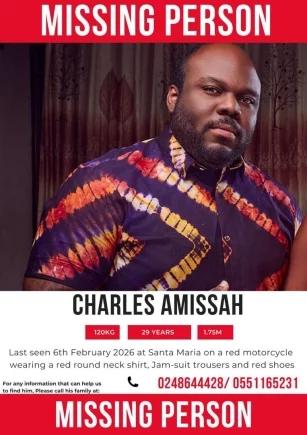
A Family Searching for a Missing Son
Throughout the ordeal, Charles’s family had no idea what had happened to him.
When he failed to return home to Adenta, relatives reported him missing at the Adenta Police Station. His photo and details were widely shared on social media:
“Last seen 6th February 2026 at Santa Maria on a red motorcycle wearing a red round-neck shirt, jam-suit trousers and red shoes.”
It was not until Monday, February 9, 2026, that the family received a call from the Nima Police Station. When they arrived at Korle Bu Teaching Hospital, they were led to the mortuary, where they confirmed that the unidentified body was their 29-year-old Charles, not the “suspected 48-year-old male” they had earlier been told about.
His sister later explained that Charles had only recently acquired the motorcycle to cope with the long daily commute between Adenta and the North Industrial Area.
When ‘No Bed’ Becomes a Verdict
This is the grim face of Ghana’s growing “no bed syndrome.”
Charles Amissah did not die at the scene of the accident. He died inside an ambulance, after trained EMTs did everything within their power, but the health system did not.
In emergency medicine, minutes matter. In this case, three hours of refusals proved fatal.
His death raises urgent national questions:
- When does “no bed” amount to denial of emergency care?
- Why are trauma victims still ferried endlessly between referral hospitals?
- Who is accountable when capacity failures cost human lives?
For one family, these questions now replace a son, a brother, and a future.
And for the rest of the country, the fear lingers:
If emergency care depends on bed space rather than medical urgency, then survival itself becomes a matter of luck.
This is not just the story of how Charles Amissah died. It is a warning about how close Ghana’s emergency care system is to collapse.
Source; Graphiconline