

Ghana’s Environmental Protection Authority (EPA) has revealed damning findings about Earl International Group (Ghana) Gold Limited and has shut down its operations for unlawful activities.
The findings are contained in a Closure Notice dated September 22, 2026, and signed by EPA’s Acting Deputy Chief Executive Officer in charge of Operations, Prof. Michael Ayamga, for the Acting Chief Executive Officer, Prof. Nana Ama Browne Klutse.
The Chinese-owned mining company, formerly known as Shaanxi Mining Ghana Limited, has been operating in Talensi, a district in the Upper East Region, since 2008. It started as a technical support service provider until it acquired a licence in April, 2019, for large-scale mining operations on a 16.02km² parcel of land (the size of 2,244 standard football fields combined) in the district.

What EPA found and Earl refused to fix
The closure follows an Enforcement Notice on Monday, 16 February 2026, after a compliance visit on Thursday, 20 November 2025, a Pre-closure Notice on Thursday, 2 April 2026, and several meetings with the company.
The notices had highlighted three major infractions:
Pumping poisonous underground water into communities
The Authority said the company continues to discharge groundwater into the environment without checking how much water is being discharged or how clean the water is, resulting in potential pollution of surface water bodies and drying up of community boreholes.
EPA revealed that this inappropriate underground dewatering (pumping water out of the mine) practice has been ongoing since its previous visit to the site and contravenes the Environmental Protection (Effluent) Regulations, 2025 (LI 2506) and Ghana Standards for Environment and Health Protection Requirements for Effluent Discharge (GS 1212: 2019).

The company has also failed to post the requisite Reclamation Bond for its operations pursuant to Regulation 40 of LI 2504. This means the company did not pay the compulsory security money meant to fix the land after they finish mining.
By law, every mining company must deposit money- called a Reclamation Bond- that the government will use to restore the land, water and community if the company destroys it and runs away. Earl has failed to pay that money. In other words, if the company destroys the district and leaves tomorrow, there is no money to reclaim the land. The burden falls on Ghana.
Building without permit
EPA said Earl International had commenced the construction of some undertakings relating to installation of new underground shafts, process plant expansion, solar farm and staff accommodation projects without the requisite environmental approvals.
According to the Authority, the projects were at different stages of completion, in contravention of Regulation 3(1) of LI 2504.

What this means is, EPA says Earl International started building four major projects without environmental permission. By law- Regulation 3(1) of LI 2504- a mining company must secure EPA approval before starting any such construction. EPA says Earl breached that law.
Dangerous tailings dam with no safety monitoring
EPA says the company is still using a poorly built tailings dam- also known as Tailings Storage Facility (TSF).
Tailings are the waste left after gold has been extracted from rock. The Authority expressed concern that the dam could collapse and its toxic water could leak into the ground, putting the communities in the district at risk.

EPA discovered that the company’s tailings dam had been compartmentalised (divided) into five cells. The company had filled cells 1, 2 and 3 of the dam with mining waste but failed to cover them, causing too much dust.
The closure notice reveals that the company is currently dumping toxic waste into cell 4 of the dam, with the cell 5 being used as a supernatant pond. A supernatant pond contains dirty water and chemicals (cyanide). That water is highly toxic. If the pond overflows or leaks, it pollutes rivers and farms.
Records, according to the Authority, revealed that the tailings dam was constructed without approval contrary to Regulation 3 (1) of LI 2504.
The closure letter said it was clear the lower wall of cell 4 on the southern side of the tailings dam had been recently repaired after it appeared to have collapsed.

EPA said the tailings dam had no instruments to check if the walls of the dam were stable or if poisonous water was leaking underground. The leakage, according to EPA, could pollute the boreholes communities in the district drink from.
Permits expired since 2023
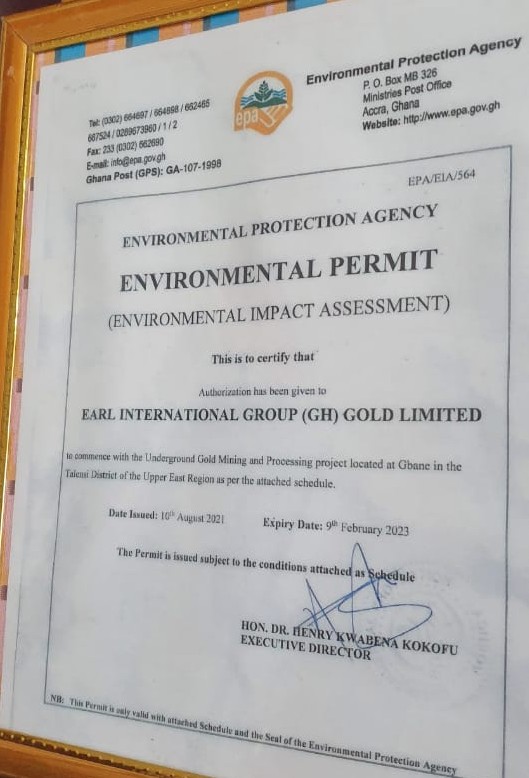
Records at the Authority, according to the closure notice, revealed that the Environmental Permits of the company, EPA/EIA/564 and EPA/EIA/562, for its Underground Gold Mining and Processing and Tailings Storage Facility operations respectively, had expired since February 2023.
The Authority said this means the company is currently operating without an Environmental Permit in breach of Regulation 3 of the Environmental Protection (Environmental Assessment) Regulations, 2025 (LI 2504).
Eight directives Earl ignored
Based on the infractions, the Authority said the company was directed to undertake corrective actions with immediate effect.
It was to initiate actions towards the acquisition of an Environmental Permit for the commencement of the construction and operation of well-built tailings dam with immediate effect. It was to initiate applications for all the identified ongoing projects without environmental permits (namely process plant expansion, solar farm and staff accommodation projects) with immediate effect.

It was to install functional monitoring instrumentation (namely piezometers, boreholes, and survey prisms) on the embankments of the tailings dam and around the TSF (tailings dam) area to monitor the stability of the embankments and any potential groundwater contamination by 15th May 2026. It was to ensure that the TSF embankments are stable and free from significant erosion.
It was to conduct a Stability Assessment of the TSF through a third-party consultant and submit the report to the Authority by 15th May 2026. It was to submit a Closure Plan for Cells 1, 2 and 3 of the tailings dam and commence the decommissioning activities by 15th March 2026.

It was to conduct a comprehensive Hydrological and Aquatic Study of the project catchment through a third-party consultant and submit a copy of the report to the Authority by 15th May 2026. It was also to implement appropriate strategies for underground dewatering (pumping water out of the mine) to ensure that the quantity and quality of the underground water is established prior to any discharge into the external environment with immediate effect.
From $2 million to $1 million fine — But still not paid
Furthermore, the Authority said the company was directed to pay an administrative fee of two million United States Dollars ($2,000,000.00) equivalent in Ghana cedis by 15th March 2026.
The closure letter said subsequent meeting agreed on a reduction from $2,000,000.00 to $1,000,000.00

The company, till date, has failed to comply with the directives and this, according to the Authority, constitutes grounds for the suspension of its Environmental Permit as stipulated in Regulation 35 of LI 2504.
Failure to protect concession from galamsey
The Authority added that recent developments show the company has failed to stop illegal miners from operating on its concession, despite a directive to all mining companies to do so. The presence of such miners, EPA affirmed, poses a serious risk to the environment.
“Based on the above infractions and the continuous operations of the Underground Gold Mining and Processing operation at Gbane in the Talensi District of the Upper East Region without a valid Environmental Permit, you are directed to cease all operational activities with immediate effect until further notice,” EPA told Earl International in the closure letter.

The Chinese company itself has a documented history of trespassing on a licensed small-scale mining concession owned by Unique Mining Group in the district some years ago.
The trespass was revealed in a report released by the Minerals Commission in 2012. Earl International paid $150,000 to Unique Mining Group in 2021 in compensation for the trespass.

At least, two other mining firms in the district have had separate legal battles with the same company over trespass-related issues.

The company, at whose site several Ghanaians have died and suffered permanent disabilities without compensation, is also currently in court as a defendant with two licensed small-scale mining firms- Nanlamtaaba Enterprise, owned by Zongdan Boyak Kolog, and Yenyeya Mining Group, property of Charles Taleog Ndanbon, in separate disputes over concession ownership.
Months ago, several workers of the company staged a demonstration against the management and wrote a letter, revealing that the company’s working environment was dangerous and unsafe for them.


Checks are being made on the company’s compliance with the EPA closure order.
Below are the pages of the closure letter EPA wrote to the Chinese company:


Source: Edward Adeti/Media Without Borders/mwbonline.org/Ghana/West Africa