

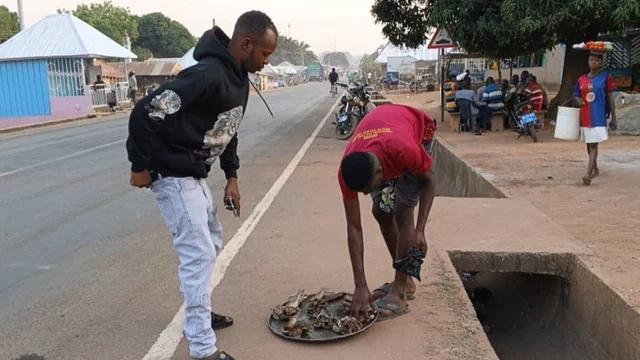
Dignity, they say, is not measured by the kind of work one does, but by the purpose, discipline, and integrity behind it. On the sun-scorched streets of Kpandai in Ghana’s Northern Region, that dignity moves quietly, fish balanced on a head pan, dreams carried steadily in the heart.
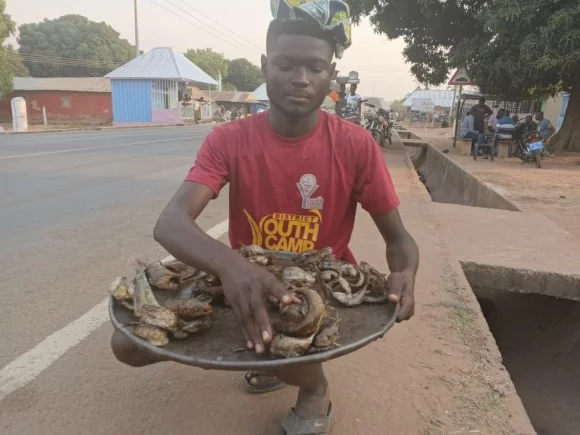
At just 21 years old, Nambu Christopher, a Senior High School graduate, spends his days walking from house to house selling fresh and dried fish to support his family. A former student of Bishop Herman Senior High School in Kpando, Volta Region, Christopher has been in the fish business for 12 years, long before he stepped into a classroom as a teenager.
He began assisting his mother at the age of eight, after the family adopted fish trading as their main source of livelihood. Today, he describes the trade as the backbone of his family’s survival and educational progress.
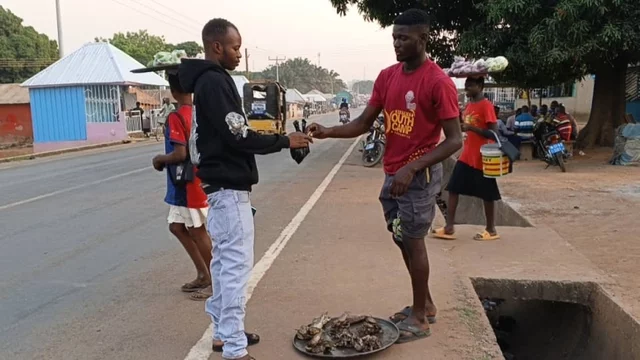
“This is the business my mother does to take care of us. I started helping her when I was eight years old. It is what has fed us and paid our school fees,” Christopher told Graphic Online.
Christopher is one of eight siblings. While two are married, the others are still pursuing their education. According to him, proceeds from the fish business have enabled several of his siblings to reach higher levels of schooling.
“I completed SHS last year. My immediate brother will complete university this year. Another is in a teacher training college, one of my sisters is a nurse, and another is a teacher. All this came from the fish business,” he said with pride.

Despite completing secondary school, Christopher has chosen to remain in the trade for now, helping to meet household needs and support his younger siblings. His workday begins in the morning and often stretches until about 6:00 p.m., with short breaks depending on the availability of fish.
Financially, he says the business brings in between ¢300 and ¢400 on slow days, while good days can yield ¢600 to ¢800, from which the cost of purchasing fish is deducted.
The journey, however, has not been without its challenges. Christopher admits that he sometimes faces ridicule, especially because of his age and gender.
“Some people call me ‘fish wura’ when they see me, but that does not discourage me. Instead, it motivates me to work harder,” he said, noting that many others have also praised his sense of responsibility and resilience.
Christopher dreams of returning to school one day to pursue a career in teaching, but for now, he has put his ambitions on hold for the sake of his family.
He has a simple message for young people struggling with unemployment or social pressure:
“No honest work is shameful. If you don’t feel shy spending money, why feel shy doing the work that brings it? Young people should not wait for handouts but work hard and plan for their future.”
In Kpandai, amid heat and hardship, Nambu Christopher’s story is a quiet reminder that responsibility can begin early, and that dignity often wears the most ordinary clothes.